


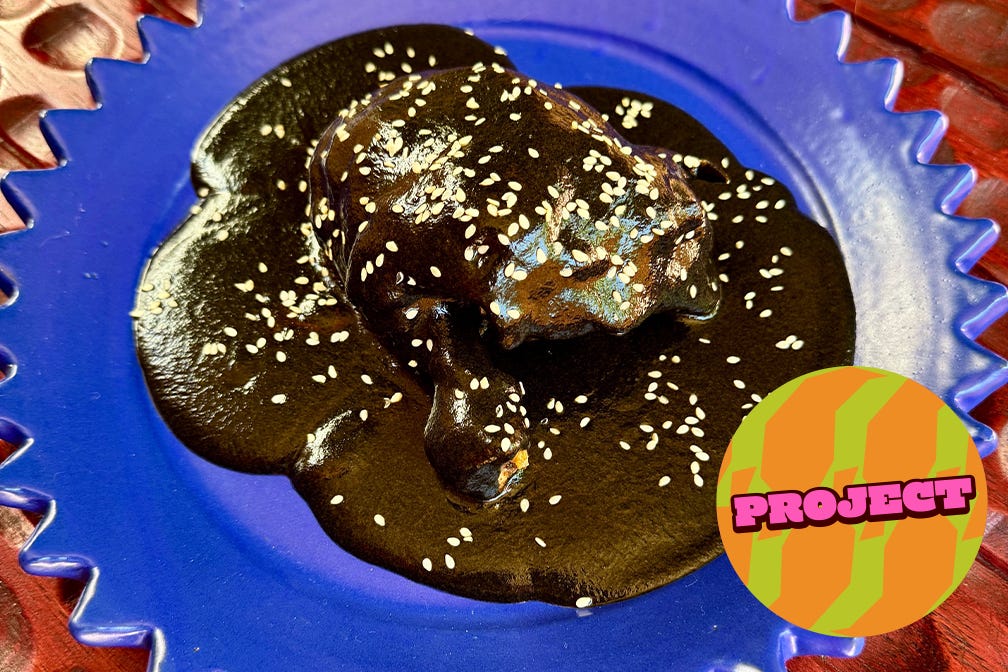
Mole negro is one of Oaxaca’s most iconic dishes, a sauce so black and complex it almost seems impossible that it begins with dried chiles, seeds, and fruit. The version you’ll find here follows the Oaxacan “burn and revive” method: the chiles are taken past the edge, charred until they resemble charcoal, then rinsed, soaked and boiled to bring their flavor back to life.
Traditional moles from towns like Teotitlán del Valle often include a step where the chile seeds are burned completely black, rinsed, and added back for color and a touch of bitterness. My approach skips that part, relying instead on the fully incinerated chiles themselves for depth. The result is a mole that’s still inky and layered, but a little smoother and rounder in flavor—less bitter, more balanced.
One small but important detail: I give the weight of the chiles in grams. It matters. Dried chiles act as natural thickeners in mole, and their size can vary dramatically from market to market and even from harvest to harvest. A guajillo in Oaxaca might be twice the size of one you find in the U.S., and that difference can make your mole too thick or too thin. If you measure by weight instead of count, you’ll always land in the right place. Think of the number I list as a guide, but let the scale be your truth.
A word of warning: this is a smoky business. If you can, burn your chiles outdoors on a grill. Indoors, crank the vent, open every door and window, and clear the pets from the kitchen. Even my industrial kitchen fan can’t keep up with the smoke. I’ve heard cooks in Yucatán joke that this process produces “Mexican napalm,” and honestly, they’re not wrong. Just be safe, laugh through the chaos, and know that the end result, a glossy, black sauce that tastes like heaven is worth every wisp of smoke.
